Mostrando entradas con la etiqueta Cosas que me preguntan. Mostrar todas las entradas

lunes, 22 de mayo de 2017

As a total amateur, I am just wondering if the very early mammals had hedgehog-like quills rather than hair. Am I correct?


Since birds developed from reptiles, feathers must have developed from scales. Between these two, there were quills giving better warmth than scales. But hedgehogs also have quills so did those quills develop entirely independantly from bird quills or did quill bearing reptiles give rise to both?

 ____________________________

- A) What was like the feature that eventually evolved into hair in mammals?
- B) Did mammal quills evolved independently from bird quills?
- C) Did quill bearing reptiles give raise to both (mammals and birds)?.

It is a very complicated matter, since the origins of feathers and hair date back to extinct animals, and it is very difficult to find remains of these traits (especially hair) in fossils. I have very little knowledge on this matter, however there is an interesting paper of Danielle Dhouailly, called A new scenario for the evolutionary origin of hair, feather, and avian scales (http://www.ncbi.nlm.nih.gov/pmc/...) that seems to throw clarify a lot about it.

Mammals, birds and reptiles are all amniota*.  It is very well documented that birds derived from reptiles (sauropsida), while the clade that gave origin to mammals (synapsida) split before the aparition of reptiles. In other words, mammals don't come from reptiles:


Source of the image: Evolution | Kusumi LabKusumi Lab

Following the footprints of the type of keratin present in the the skin of mammals and birds, he suggests that mammal hair comes from "hypothetical glandular integument of the first amniotes, which may have presented similarities with common day terrestrial amphibians", whileas feathers "may have evolved independently of squamate scales, each originating from the hypothetical roughened beta-keratinized integument of the first sauropsids. The avian overlapping scales, which cover the feet in some bird species, may have developed later in evolution, being secondarily derived from feathers."
I.e, hair neither comes from reptile scales nor from feathers. Also, feathers don't come from reptile scales. So the answer to question B) is yes, mammals' quills evolved independently from birds quills, and the answer to question C) is no, quill bearing reptiles didn't give rise to them both.
But...what did hair look like when it appeared for the first time?
When did hair arise?. It seems that Pelycosaurs lacked scales, and propbably also all basal therapsids.  Accordingly with wikipedia "The hairs of the fur in modern animals are all connected to nerves, and so the fur also serves as a transmitter for sensory input. Fur could have evolved from sensory hair (whiskers). The signals from this sensory apparatus is interpreted in the neocortex, a chapter of the brain that expanded markedly in animals like Morganucodon and Hadrocodium.
The more advanced therapsids could have had a combination of naked skin, whiskers, and scutes. A full pelage likely did not evolve until the therapsid-mammal transition."
Due to their increased surface/volume ratio, smaller animals find it more difficult to internally thermoregulate because their insides are closer to their outsides. Having insulating fur when tiny would be helpful.
So the answer to question A) is probably -and only probably- like whiskers.
Interesting readings:
and for not shy readers the discussion about the first paper posted in archosaurheresies is interesting  (The origin of feathers and hair (part 2: hair) ). But, caution, the blog reflects the opinions of his author who clearly opposes to many of the views of paleontologists. So you have to read it with an analytical eye.
viernes, 5 de mayo de 2017

Si los pájaros son dinosaurios, ¿por qué no son todos los vertebrados son peces?. ¿Son solamente dinosaurios cuando hablan cladistica o también parala clasisicación Lineana?


Otra pregunta en Quora que me encantó, porque expresa muy bien el estupor que provoca la cladística por uno de sus muchísimos enredos, llamar con el mismo nombre a todos los animales, y resto de seres vicos, que descienden evolutivamente de un origen común, de hecho las líneas en la que explican la pregunta son geniales: 

" Entiendo que con los clados, los pájaros son dinosaurios, pero al considerar los clados, los pájaros son peces, cnidarios, etcétera. Esta distinción es casi inútil para los fines generales del lenguaje, donde llamar a todo una bacteria no tendría sentido. Por lo tanto, a los efectos del lenguaje casual, ¿son los pájaros realmente dinosaurios? "

La verdad es que releyendo lo que contesté (y después de querer darme de tortas varias veces, ante la cantidad de barbaridades del google translator que yo había dejado pasar tranquilamente) creo que me he quedado muy comedida en lo que digo sobre la cladística, y que debería haber contado alguna cosilla más acerca de lo enredosa que es.

Las aves son dinosaurios para ambos sistemas de clasificación

Las aves son dinosaurios desde ambos puntos de vista, aunque esto de decir que los pájaros son dinosaurios conlleva algunos problemas para la clasificación linneana (1). Y no me malinterpreteis, me gusta mucho la clasificación linneana y prefiero que sea la primera que se enseñe a los niños porque es una gran descripción del mundo tal como lo vemos; algo que la cladística no puede ser por su definición, dado que tiene que incluir características de organismos extintos. Aquí en España los niños aprenden conceptos de taxonomía demasiado  temprano, en los primeros grados de Primaria, y ¿cómo podrían entender los rasgos comunes, descriptos por la Cladística, entre reptiles y aves cuando son menores de 10 años ?. La respuesta es "a duras penas si es que llegan a entender algo" de los tipos de articulaciones de las extremidades, y las formas de las caderas y las costillas.

Volviendo a los dinosaurios, es un grupo que no se definió conla gama de caracteres que podemos observar en un animal vivo, que incluyen características externas como la apariencia, rasgos de la piel (tener pieles, plumas, glándulas, capas ...), el metabolismo; rasgos (tales como si podían mantener un nivel de temperatura interna independientemente de las condiciones ambientales o no, cámaras en el corazón, etc), morfología esquelética y otras.  

No fue posible porque la descripción se hizo a partir de los restos de fósiles que sólo mostraban rasgos esqueléticos (2), de ahí que todo el grupo se tipificara a partir de algunos puntos del esqueleto que se consideraron relevantes. No hay forma de comparar cómo describieron mamíferos, aves y reptiles con la forma en que lo hicieron con los dinosaurios.

----------------Y es cierto que en algunos casos es cierto que el parecido es evidente...


Fuente de la imagen: aurornis Xui: Un nuevo dinosaurio volador que vivió hace unos 150 millones de años ha sido descubierto en China.
Si bien estos dinosaurios se descubrieron mucho después de que se hiciera la lista de caracteres con las que tenía que cumplir un bicho para que se le considerara un dinosaurio de pro.


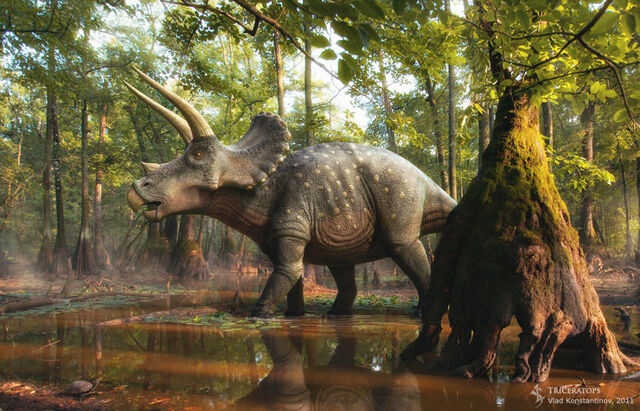
Pero en otros muchos, no hay forma (sencilla) de relacionarlos:

Archivo:735cbf2c1c234d4171714ce229959dff-d3ib9f2.jpg
Triceraptos, arte de Vlad Kostatinov, 2011

---------------


Lo que sucedió es que, de acuerdo con las características clave del esqueleto, las aves deben ser incluidas en el grupo de dinosaurios (desde el punto de vista de Linneano) o están en el clado de dinosaurios (desde el cladístico).

Como he dicho ningún otro animal existente en la actualidad se ha clasificado así, digamos que al tener al animal vivo y completito se fijaron en muchos más detalles. Sin embargo con los dinosaurios el punto de partida son huesos y articulaciones y les salió un grupo (clado para la cladística) demasiado grande que la pobre clasificación Linneana, que tuvo que engullir la píldora como pudo, y los dejó en el rango de superorden. Para hacernos una idea, tanto aves como mamíferos son clases, el tipo Orden va por debajo, pero el tipo Superorden es una entelequia que según como pique va por encima Orden, por debajo o no se sabe. Un apaño, vamos. 

Y ya que hablamos de apaños, la clasificación que se da de aves y mamíferos en wikipedia es un pastiche entre cladística y linneana bastante difícil de interpretar.

 Los pájaros cumplen todos los "debe tener" para ser nombrados dinosaurios por si mismos, y no como un grupo taxonómico derivado de los dinosaurios. Por supuesto que hay muchas polémicas en torno a este punto, ya que algunas aves presentan adaptaciones anatómicas muy originales al vuelo que les diferencian de los dinosaurios más "primitivos" (3). Algunos anatomistas, especializados en aves, incluso sostienen que podrían derivar de un antepasado más antiguo que sólo estaba relacionado con los dinosaurios, pero no era un dinosaurio (4). Creo que los científicos que defienden esos puntos de vista no han demostrado que las aves carezcan de los caracteres esqueléticos que los hacen dinosaurios, por lo menos hasta ahora,lo digo porque la ciencia se basa sobre la duda y la prueba sistematizada.
De hecho los críticos que enlacé abajo han tenido amplias refutaciones. Probablemente veremos más de esta polémica en los próximos años, y este es el tipo de discusión que me gusta, porque a pesar de que pueden ser realmente aburrido para los taxonomistas, para el público en general muestran algunas características realmente interesantes del animal estudiado. Y también, es como una verdadera telenovela científica en Internet, que por cierto resulta muy entretenida por el ardor guerrero de sus actores. Pero para el propósito de lenguaje no científico, las aves pueden llamarse aves, y podemos olvidar por un tiempo que son dinosaurios.

Por último, en nuestra vida diaria, en la medida en que no nos interesa la historia evolutiva de algún organismo o algún rasgo de algún ser vivo, me parece mucho más útil y sorprendente hablar de ellos en la forma en que vemos y experimentamos nuestro mundo; y es aquí es donde la clasificación Linneana hace el mejor papel.  

¿Ves esos hermosos caballos de patas largas como peces?. De hecho, nadie lo hace. La insistencia de llamar dinosaurios a los pájaros proviene del hecho de que la polémica entre partidarios y retractores de esta clasificación sigue viva, y nada es más ruidoso que un campo de batalla bajo los tambores de internet.
---------

Pero no quedaría tranquila sin deslizar algunas palabras del fastidio que me provoca la cladística. En primer lugar, como ya se ve con esto de los pájaros y los dinosaurios, provoca unas complicaciones monumentales para ver el mundo real actual. En segundo lugar, es  traidoramente ambigua, un taxón puede ser cualquier cosa, y como dice el que hizo la pregunta, al final somos todos bacterias. En tercer lugar es absurda para la vida real, me remito a las quejas primera y segunda. En cuarto lugar sus defensores son estúpidamente prepotentes, toda clasificación tiene sus problemas, toda. La vida siempre va a ser mucho más compleja que lo que logremos entender, pero la Cladística ya nace coja, porque destierra el concepto de Transferencia Horizontal de Genes, que se está rebelando clave para explicar la evolución de la vida. Pero es que además me asombra la Cladística filética (vayanombrecito...) con sus diagramas en los que cada grupo se bifurca en dos, y sólo en dos. ¿Por qué en dos?, ¿por qué no uno ni tres?, ¿cuándo?..a partir de qué grado de qué caracter. Tampoco me gusta, y lo he dicho muchas veces, que a la pregunta sobre qué conjunto de caracteres decide que un animal sea de un taxón u otro, la única respuesta que los fanáticos de la Cladística dan sea "el ordenador lo sabe".

__ Enlaces y una introducción a algunos problemas y controversias derivados de la clasificación de dinosaurios. Yo sólo recomiendo punto 1 y 4 a dino freaks.


(1) Bueno, este punto es molestamente largo, estoy de acuerdo. Pero como he visto tantas personas confundidas con la idea de que los dinosaurios son pájaros, me gusta explicar por qué se sienten tan extrañados con ella.Los problemas que la clasificación Linneana debe hacer frente debido a que las aves son en realidad los dinosaurios derivan de que los dinosaurios incluyen animales que se asemejan mucho a los reptiles y otros que, bueno, son aves y ya está.Para la persona corriente el problema se puede poner como "Así que cuando pensamos en el término dinosaurio, ¿qué estamos pensando, en un pájaro o un reptil, o en ambos?". De hecho este asunto me recuerda el cubo de Necker, una ilusión óptica en lo que podemos ver el mismo dibujo de un cubo que mira para arriba, abajo o ambos alternativamente.


En cuanto a los dinosaurios, no existe tal dilema, como he dicho en el texto, los dinosaurios se definieron en base diferente que cualquier animal vivo Clase (reptiles y aves son Clases de acuerdo a la clasificación de Linneana), por lo que no hay contradicción en que los grupos dino animales De ambas clases. Es un poco incómodo para los partidarios Linnean, pero no un misile nuclear que destruirá el concepto.Los partidarios de la cladística, por otro lado, tienen sentimientos más fuertes sobre los reptilia de la clase Linneana (es decir, los reptiles). Algunas escuelas de pensamiento quisieran redefinirlo de una manera que incluya pájaros. Pero también tienen que hacer frente a sus propios problemas, porque no está claro cómo agrupar los diferentes tipos existentes de reptiles según sus caracteres evolutivos. Pero eso no les impide opinar alegremente sobre lo que tendrían que hacer los Lienanos.


 Por el momento los reptiles son una pesadilla para los biólogos evolucionistas y los fanáticos de la cladística, buenos para los viejos y valientes animales escalados. ¿Quién quiere que a sus hijos se les diga que las aves y los reptiles son iguales a la tierna edad de siete años ?.  

De hecho, los dinosaurios no son el único grupo que desafía el tradicional grupo de Linneano, sólo el más popular. Si los Syiapsidos hubiesen sido tan conocido como los dinos, habríamos asistido a una larga y animada discusión acerca de si son retiles o mamíferos o qué. 


 Por último, los sinapsides se dividieron de los reptiles. He traído el ejemplo de los sinapsidos para hablar de la complejidad de clasificar animales extintos que presentan caracteres que los hacen cercanos a dos clases Linneanas diferentes, especies o lo que sea.  

Al final, hacer clasificaciones es dibujar fronteras que desde una perspectiva aérea pueden parecer ser muy claras, pero cuanto más cerca se llega a estas fronteras, más artifícales y discutibles aparecen.  

Esta es la lección que nosotros, los laicos, podemos sacar de los problemas con la clasificación de los dinosaurios. Las clasificaciones las hacen los humanos y no hay criterios divinos para hacerlas.

(2) ¿Cuál es el diagnóstico científico de lo que es un dinosaurio, y lo que es sólo otro arcosauro? Varias características esqueléticas se utilizan actualmente como características de dinosaurio de diagnóstico. También puede ver una imagen en pantalla grande de un esqueleto de dinosaurio para una lección de anatomía: Morphology of the Dinosauria

(3) ¿Son los pájaros dinosaurios?  La nueva evidencia obscurece el cuadro (recuerde que las objeciones expuestas en este artículo están refutadas hoy en día...aunque, bueno, no del todo) .

(4) Longisquama (el artículo está refutado, ¿para siempre?) Pero realmente encuentro Longisquasma asombroso).


jueves, 4 de mayo de 2017

¿Hay gatos persas de tipo "cara de muñeco" en Irán?

Tipo de persas variedad "cara de muñeco"


Bueno ... Creo que es extremadamente difícil encontrar este tipo de gatos de pelo largo y cara de muñeco en el Irán de hoy en día y que siemrep lo fue.

Los primeros criadores de gatos eran mucho más sensatos que los de hoy en día


Este pobre gato es espantoso


Otro ejemplo de cómo los estándares extremos de una raza producen animales feos, malformados y con numerosos problemas de salud.


Porque el nombre de la raza es sólo orientativo, y no una muestra de precisión científica.
Cuando la pasión de la cría de gatos de raza comenzó en Europa en el último cuarto del siglo XIX,  con una intensidad especial en Gran Bretaña, el nombre de las nuevas razas se dio para resaltar la procedencia exótica de algunos de los gatos utilizados para iniciar la línea. Y la fiabilidad del nombre no era el objetivo principal que tenían en mente estos criadores. Esta tendencia se utiliza todavía en nuestros días y es el motivo por el que tenemos nombres como "exóticos","gato leopardo" (¿un leopardo y un gato ?, hmm ... ¿entienden lo que quiero decir?) Y otros como el gato de Singapur. En el caso de los persas, wikipedia tiene un buen texto sobre sus orígenes:
    No está claro cuándo aparecieron por primera vez los gatos de pelo largo, ya que no hay especímenes de pelo largo conocidos del gato salvaje africano, el antepasado de la subespecie doméstica. En el siglo XIX se afirmó que el gen responsable del pelo largo fue introducido a través de la hibridación con el gato Pallas, pero la investigación a principios del siglo XX refuta esta teoría. [Cita requerida]
    Foto: Un Angora / persa de "The Royal Natural History" (1894)

    Los primeros ancestros documentados del persa fueron importados de Khorasan, Persia, en Italia en 1620 por Pietro della Valle, y de Angora (ahora Ankara), Turquía, en Francia por Nicholas-Claude Fabri de Peiresc alrededor de la misma época. Los gatos Khorasan estaban cubiertos de gris mientras que los de Angora eran blancos. De Francia, pronto llegaron a Gran Bretaña. [2] Los gatos de pelo largo también fueron importados a Europa desde Afganistán, Birmania, China y Rusia. El entrecruzamiento de los diversos tipos era común, especialmente entre Angoras y persas. [3]
    Investigaciones genéticas recientes indican que los persas actuales no están relacionados con gatos del Cercano Oriente sino con gatos de Europa Occidental. Los investigadores declararon: "Aunque el gato persa temprano pudo haber originado de hecho de Persia antiguo, el gato persa moderno ha perdido su firma phylogeographical." [4]

Así, había antepasados ​​de tipo persa antiguo en Khorasan, pero probablemente no se asemejan mucho a este tipo antiguo, ya que la raza persa original provenía de la mezcla de gatos Khorasan grises y gatos blancos Angora. 

Si alguien quiere publicar algunas fotos de gatos grises medianos de pelo largo Khorasan, probablemente podemos ver un gato similar a los que originaron la raza persa tradicional, aunque hay muy poco de su legado en los gatos persas de hoy.Y es una lástima. Hoy en día el estándar persa es mucho más feo que tradicionalmente, y lo que es peor tienen muchas problemas relacionados con el extremo acortamiento de la boca. ¡Los estándares extremos de la raza, especialmente el de gatos persas y de gatos siameses deben ser revisados y eliminadas estas exigencias que son antisaludables para los gatos ​​!.Tal vez mi opinión no es muy popular entre los amantes persas, pero piensa en la salud de estos gatos, por favor. Los gustos y las aversiones no son tan importantes (me encanta lo extremo siameses que parecen) como asuntos de salud.

https://www.quora.com/Are-Persian-cats-in-Iran-today-the-traditional-doll-faced-variety-or-no/answer/Susana-Molina?__filter__=all&__nsrc__=1&__snid3__=1006575234

jueves, 30 de marzo de 2017

¿Pueden los animales sonreir realmente?, de forma similar a los humanos


Otra pregunta de Quora, es rapidita y el enlace de Lola Ya Bonobo es muy interesante. Recordad que los santuarios de animales siempre andan necesitados de ayuda,yo lo dejo caer aquí.
 

 La gente sonríe, así que los seres humanos son animales que sonríen, por lo tanto algunos animales sí sonríen. Si hubieras añadido el tema Biología Evolutiva a tu pregunta, simplemente habría escrito que la gente sonríe así que algunos animales sonríen. 
Los bonobos también sonríen: Bonobo smiles - Lola Ya Bonobo.


 Esto puede ser un poco polémico para quines hayan escuchado que los grandes simios sólo hacen "sonrisas de miedo" en apariencia muy similares a las humanas, pero que responden a estímulos que les asustan. Sin embargo n el caso de bonobos pueden hacer ambas cosas "sonrisas de miedo" y grandes sonrisas abiertas. 

Los chimpancés sonríen, o ponen "cara de jugar"hacen playfaces:
 

Que son muy diferentes a las sonrisas de miedo o muecas de miedo. Debajo un jemplo de las segundas (ver a la chimpancé a la izquierda abriendo la boca y mostrando sus dientes)


Acerca de los gatos y perros, tengo gatos, que muestran su mente abierta social y buen humor en muchos sentidos, pero nunca mostrando una sonrisa, al menos en mi experiencia.No tengo miedo de arrojarme a los muros de la llamada falacia antropomórfica, en mi experiencia la mayor falacia es permitir que tus prejuicios te impidan escuchar lo que un buen observador puede decirte, y ver lo que puedes ver con tus propios ojos . Por lo tanto, como dicen va en español: soy todo orejas - estoy abierto a escuchar - si alguien tiene un testimonio sobre un perro o un gato con una expresión similar a una sonrisa para mostrar buen humor.

miércoles, 18 de enero de 2017

Are there reliable reports of wild adult animals with cleft palate?

 I know that the probability is extremely low, as all the cases I know in domestic animals with this bird condition have had to be hand reared. Also, I am aware of what is this condition, I'm not requeting for a description of it. I'm just curious about if any wild animal survived against the odds.
______________________________________________________________________________


First case I have met. It is not an adult, but at least is a weaned wild animal, which means that the criature was able to be breastfed in spite of her congenital defect. I don't know the physiology of process of breastfeeding in elephant seals so well to know wether the mother can "inject" milk to the puppy is this detail would be very interesting to know.
TVA, a northern elephant seal weaner rescued earlier this year, rests  inside a rubber carrier equipped with a heating pad on a wet Thursday  morning at The Marine Mammal Center in Sausalito. She is suffering from  malnourishment due to not hunting effectively after having been  weaned from her mother. Beachgoers found this skinny pup alone and in a  bad location with humans around, so the Center rescued her. Luckily, at  The Marine Mammal Center she’ll get the nourishment and medical care she  needs to fatten up and become strong enough for release back to the  ocean. In many ways she is like the other thousands of seals and sea  lions that have been rescued by the Center since 1975.

In the articled is also told thet TVA has a "humpack" due to bone malformation.

To read more: Elephant Seals and Birth Defects

lunes, 16 de enero de 2017

Are there fishes with necks?

here were. In the Devonian period existed a singular species of fish, so singular it has its own genus, the Tiktaalik, a extinct sarcopterygian (lobe-finned fish) with many features that are well observed in four-legged animals, thus tThe Tiktaalik is understood as transition form from fish to amphibians.  Well-preserved fossils were found in on Canada.
Tiktaalik had  internal and external nostrils and  a neck, with the pectoral girdle separate from the skull. This would give the creature more freedom in hunting prey either on land or in the shallows.

And they were so gorgeous...well, no, they weren´t gorgeous at all, but they had necks, so why care about the rest...
There are. Seahorses have a neck the can bend upside down and that lets them feed the the way they do.


and they are so gorgeous, this time for real.
I don´t know how far is the skull of Seahorses form their pectoral girdle, looking to them moving it seems that they are pretty well far to give their necks the right to be considered real necks.

Tiktaalik image: http://en.wikipedia.org/wiki/Tik...
Seahorse image: http://www.scientificamerican.co...

domingo, 15 de enero de 2017

Which animal/bird/insect best describes such situation?

 - X is looking for Y.
- Z is also looking for Y.

And
- W makes Y available to both X and Z.

I am looking for a name of animal/bird/insect who are facing such situation in their food chain. It would be great if someone provide names of W,X,Y and Z.


--------------------------------------------------------------------------------------------------------------------

[Note: I will answer expecting that your question isn't a homework, because as I have told I find it very interesting. But in case it is, I wouldn't show your teacher these rambling divagations I'm going to write here, teachers frequently expect that the answers are centered on their local area, so...good luck if you use this material...].
[Note 2: I think that in marine habitats this type of situation is more frequent given that there are many more intermediate predators than in terrestrial habitats].

Such as you have posed it, I don't remember any direct example of two different insectivore birds looking for the same kind of insect, and an aditional element (W, you don't specify wether W is a bird, or even an animal) making those insects avalaible to their predators.

But I can tell of some similar situations:

1)  W accidentally or as the collateral result of its activities makes some preys accessible to some predators. There are a bunch of situations of this kind occurring in many ecosystems everyday, to tell you about some:

  •   W is a maize farmer who uses flood irrigation methods. Y are some   different types of flies (Diptera) that lay their eggs in the flooded fields of W. As a result massive quantities of adult flying insects are avalaible for many insectivore birds, migratory ornot, such as sparrows, swifts, swallows, bee-eaters, etc, etc. They are yor X and Z (and the rest of the alphabet, and more :)).

  • W is a bird that accidentally disperses invertebrates out of their habitats, burrows or even hosts. Thus these inertebrates are made available for some predators that live/chase well far from those habitats and biotopes, and that in other case wouldn't have very few chances of preying on them.

To give them name, W could be piscivorous birds, Y propagulates, and X pelicans.


There is a very interesting paper about the importance of birds as invertebrates dispersers in arid Australia: Page on ebd.csic.es.

2) W voluntarily tells X and Z the location of Y in order to get access to Y or some products of Y.

Honeyguides are named for a remarkable habit seen in one or two species: they guide humans to bee colonies.  Once the hive is open and the honey is taken, the bird feeds on the  remaining wax and larvae. This behavior is well studied in the greater honeyguide; some authorities (following Friedmann, 1955) state that it also occurs in the scaly-throated honeyguide, while others disagree (Short and Horne, 2002). Despite popular belief, there is no evidence that honeyguides guide the honey badger.

I give it up to you to name X, Y, Z, W in those cases.

sábado, 14 de enero de 2017

What is the cephalopod with the longest lifetime?


According to Smithsonian data, Nautilus can live more than 15 years.
Cephalopods - National Zoo


Slowy but with its advantages, here is a Nautilus.

Sill looking for more data, because I love exceptions, when I find anyone, I will put it here.

Edit #1:
Though cephalopods have very short life expectancy, on average from 6 months to 2 years, it has been discovered that Graneledone boreopacifica females can live for more than 53 months. In fact thiese 53 months is what a female spent caring her eggs before they hatch.
Source:
Longest-Living Octopus Found, Guards Eggs for Record 4.5 Years

viernes, 13 de enero de 2017

Are there reports of domestic cats hunting cooperatively?

There are:
Even co-operative hunting does  sometimes occur with closely bonded cats. Littermates Bubble and Squeak  were two such hunting partners. Between them, they quartered the field  in front of my home, flushing out field mice for each other and often  sharing the catch. 12 year old Scrapper regularly teamed up with  unrelated 6 month old Aphrodite to hunt the birds that devastated my  fruit bushes. This was a beneficial partnership as Scrapper, who had no  teeth, flushed birds towards Aphrodite who despatched them, but didn't  eat them! There was no doubt that Scrapper masterminded the operation as  Aphrodite was not very bright!
Discussions with cat-owning friends have provided many more accounts  of cats which flushed prey from flower borders into the waiting paws and  jaws of the cats they lived with.
In 1996, studies of cats in the Galapagos Islands indicated that some  cats will hunt co-operatively to increase the likelihood of successful  hunts. This observation was made when prey was difficult for a single  cat to catch. At the cat shelter where I work, ferals Kim, Jade and Gem  (littermates) did not hunt as a group but they frequently shared their  kills.

Source: Are Cats Really Unsociable?

jueves, 12 de enero de 2017

Which wild animals, if any, teach their young in communities / packs / classes or other groups?

Yes, there are some species that share teaching responsabilities in their communities. Many more that the few examples I'll give here.

              Meerkats teach their juvenile how to handle scorpions to remove the edible parts without being injured with their stingers.
This is a two lessons curriculum (so to speak). First, they provide the young students with dead scorpions with their stingers removed, so that they can handle them safely in order to access to the edible parts.
When the adults think that they have mastered this art, they provide them with dead scorpions with their stingers still attached.

Meerkats are highly social animals that live in organized communities with an alpha couple, which is in normal circumstances the only reproductive one. It is interesting that meerkats can change communities and therefor not all the animals in a given group have to be related to the alpha couple.


https://en.wikipedia.org/wiki/Me...

What are some rare colors of common animals that exist that most people aren't aware of?

The Akhal-Teke, a beautiful russian breed of horses, has a fur with metallic shines: Akhal-Teke.
  • Many cephalopods are actually bioluminiscents (Bioluminescence)
  • albino dolphins are pinkish due to the extreme irrigation of their fat.

    martes, 10 de enero de 2017

    Does laying eggs or not laying eggs have any impact on flying animals?


    What are the chances that an animal which does not lay eggs will one day evolve into a flying animal? Does laying eggs or not laying eggs impact the survival chances of flaying animals?
    _____________

    Not being particularly amused by our own way or reproduction, and I talk from my own experience, I mean I don't belong to the supermammy supermammal party, I'll try to give an objetive answer to this question, and fisnish it before it comes too long and boring.
    Evolutively speaking eggs came first, before than oviparity and fliying. Powered flight has appeared only 4 times in the history of animals: insects, peterosauros, birds and bats, see Flying and gliding animals for a longer explanation (interestingly enough 3 of them in vertebrate animals).  Vivipary has appeared more than once as well, with different hints it has been reported in some frogs (there are cases of ovoviviparity and hemotrophic viviparity), salamanders and sharks (histotrophic viviparity), and of course in all mammals excepting monotremes. There are also many cases of viviparity in plants.

    • In flying insects the rule is oviparity, although there is an orden of true flies that exhibit a form of viviparity, so we can study gravid flies, for example in the tse-tse fly. (Adenotrophic viviparity).
    • (A gravid tse-tse fly: Adenotrophic viviparity).
    • All pterosaurus described to this date were oviparous.
    • All birds are oviparous.
    • All flying mammals, i.e the almost 1,000 species of bats, are viviparous.

    So this trend clearly points to two conclussions:

    - There is a significant higher chance of flying occurring among oviparous animals than in viviparous ones. And very probably due to that viviparity imposes some restrictions to the development of flight, given that it is (on average) more exigent in natural resources than viviparity. Although there are cases of oviparous animals that have turned viviparous after having acquired flight, like the tse-tse. But exceptions are the rule in nature!.
    - It is possible to acquire power flight for an obliged viviparous animals, and thrieve, there are the bats to prove it. But in general, bat flight is more energy demanding than bird flight and thy are in slight disadvantadge in front of birds.

    sábado, 26 de noviembre de 2016

    What are some amazing moments of bonding between animals from different species?


    I love this question on Quora because I love animals. I find it uplifting, so let's have a nice moment. Enjoy...
    _____________

    1)  Mzee is a Aldabra giant tortoise (Aldabrachelys gigantea), a species which habitat is in the Seychelles. Owen is exactly what you could expect from a hipoppotamus.

     Let's start with one of the most surprising pals I had never expected. Because one of them is a reptil, and the other a mammal. You may think that in this case the bond could only flow in one direction (from mammal to reptil), very probably, but it was fundamental for the well being of the young mammal.
    Owen and Mzee


    They live in the Haller Park in Kenya. In December 2004, tthe terrible tusnami separated Owen, then a juvenile hippo, from his herd. he was rescued and carried to the Haller Park Rescue Center. Having no other hippos to interact with, Owen immediately attempted to  bond with Mzee, whose large domed shell and brown color resembled an  adult hippo. They formed an odd friendship that continued until 2006,  when it was determined that Owen had grown too large to safely interact  with Mzee. Today they live in separated enclosures, and Owen is doing a great job in socializing with other hippos, which reveals that the effect of the perceived bonding with the tortoise was very positive for the young mammal.


    2) Whales interacting with dolphins: Sperm Whales 'adopt' a deformed dolphin, and whales giving dolphins a lift.

    These kind of bondings can occur in the wild. Despite they can be temporal, we can't deny that they defy our understanding of humans as the only ones that can understand another species's animal suffering and help them, and also...what puzzles me more...that they enjoy playing with another species.

    Let's start by an amazing example, this video depicts a very rare interaction between sperm whales and an  adult bottlenose dolphin with a spinal malformation (i.e. scoliosis).  This represents the first time this type of non-agonistic (friendly)  interaction has been recorded for sperm whales. We published a  description of these interactions in the scientific journal "Aquatic  Mammals".


    Surprising, isn't it?. But what if I tell you that scientists have filmed whales playing with dolphins...playing, not harrasing or bullying.

    Whales give dolphins a lift.


    Many species interact in the wild, most often as predator and prey. But  recent encounters between humpback whales and bottlenose dolphins reveal  a playful side to interspecies interaction. In two different locations  in Hawaii, scientists watched as dolphins "rode" the heads of whales:  the whales lifted the dolphins up and out of the water, and then the  dolphins slid back down. The two species seemed to cooperate in the  activity, and neither displayed signs of aggression or distress.

    3)  Adopted pets can form bonds incredible strong, because they know what is not to have them. When there is a disability included in the equation, the bondings are truly impresionant.

    I've talked about wild animals in a rescue center, and wild animals in the wild, but the greatest source of these unthinkable bondings are just average people homes

    Pwditat the rescued straycat and Terfel the blind dog:


     And, on the other hand, Murdock the blind adopted cat and the family dog who adopted him as his best friend (the name of the dog wasn't mentioned in the article).


    Here are the links to know more about them.
    http://www.lifewithcats.tv/2012/...
    http://lovemeow.com/2013/10/murd...

    4) There is an entire channel of NatGeo dedicated to tell this kind of stories.
     http://channel.nationalgeographi...
    Here is the story of a ten y.o hen and a very handicapped toy dog, that are best buddies:

    martes, 22 de noviembre de 2016

    Why are poop-throwing chimpanzees more intelligent?

     http://phys.org/news/2011-11-poop-throwing-chimps-intelligence.html

    Ok, some questions on Quora are incredibly funny. And, ah, oh, yes...some field studies too bizarre.
    This is one of the first things I wrote on Quora, be patient with my English, I was starting, and also forgive me some typos...but poo throwing chimps and intelligence, is there anything more exciting?.
    ________________

    From suchanaughtymonkey.wordpress.com

    Are there -not handycapped- chimps that can't poop throw ?.
    The paper says that better poop throwers were more intellegent becaus:

    After making their  discovery regarding the parts of the brain that appear to be involved in  better throwing in chimps, the team tested the chimps and found that  those that could throw better also appeared to be better communicators  within their group, giving credence to their idea that speech and  throwing are related. Interestingly, they also found that the better  throwing chimps didn’t appear to posses any more physical prowess than  other chimps, which the researchers suggest means that throwing didn’t  develop as a means of hunting, but as a form of communication within  groups, i.e. throwing stuff at someone else became a form of self  expression, which is clearly evident to anyone who has ever been  targeted by a chimp locked up in a zoo.
    (source, the same paper you mentioned, Researches find poop-throwing by chimps is a sign of intelligence)

    And here you have the causes, in the same paper:
    - It has been  hypothesized that neurological adaptations associated with evolutionary  selection for throwing may have served as a precursor for the emergence  of language and speech in early hominins.
    -These results suggest  that chimpanzees that have learned to throw have developed greater  cortical connectivity between primary motor cortex and the Broca's area  homologue. It is suggested that during hominin evolution, after the  split between the lines leading to chimpanzees and humans, there was  intense selection on increased motor skills associated with throwing and  that this potentially formed the foundation for left hemisphere  specialization associated with language and speech found in modern  humans.

    (source, the same paper you mentioned, Researches find poop-throwing by chimps is a sign of intelligence)

    In a nutshell, the development of precisssion in poop throwing is associated with the cortical connectivity in brain structures essential for language in humans.

    The easy joke is language came from the appropiate use of poop.
    ----------------------------------------------
    But, if you ask me, the study goes very far in use of chimp natural behaviour to analyse early human development. As chimp can´t not use a very structurate group of sounds, due to morphology issues, for me there is a human biass in analyse their behaviour in this study.

    viernes, 18 de noviembre de 2016

    What hybrid animals are fertile?

     There is a very interesting phenomenon called hybrid speciation by which hybridation between two different species leads to a third one. Needless to say that this process occur because the (sufficient number of) hybrids are fertile.
     Although this type of speciation is more common in plants than in animals, there are some animals species that can be listed in this category (as DNA tests have shown):

    • Lonycera fly (Lonicera fly), most likely to be the hybrid of blueberry maggot and snowberry maggot. They feed on honeysuckles, that are also a type of berry, not very innovative in this sense.

    • Great skua or perhaps Pomarine skua (Great skua) : DNA tests have found a great similarity with the genetics of the pomarine skua, despite they look very different. Many  ornithologists now believe either that the Great Skua originated as a  hybrid between the pomarine skua and one of the southern-hemisphere  species , or that the  pomarine skua evolved from hybridization of the great skua and one of  the small Arctic species. In this case it is still on controversy which species came first.
    Great skua

    Pomarine skua.
    (I had curiosity about how dissimilar they are).


    • Clymene dolphin, formerly known as the short snouted spinner dolphin (Clymene dolphin): Anatomical and behavioral traits suggested that this species is a hybrid of the spinner dolphin (Stenella longirostris) and the striped dolphin (Stenella coeruleoalba), and DNA testing has shown that it is indeed a hybrid species.